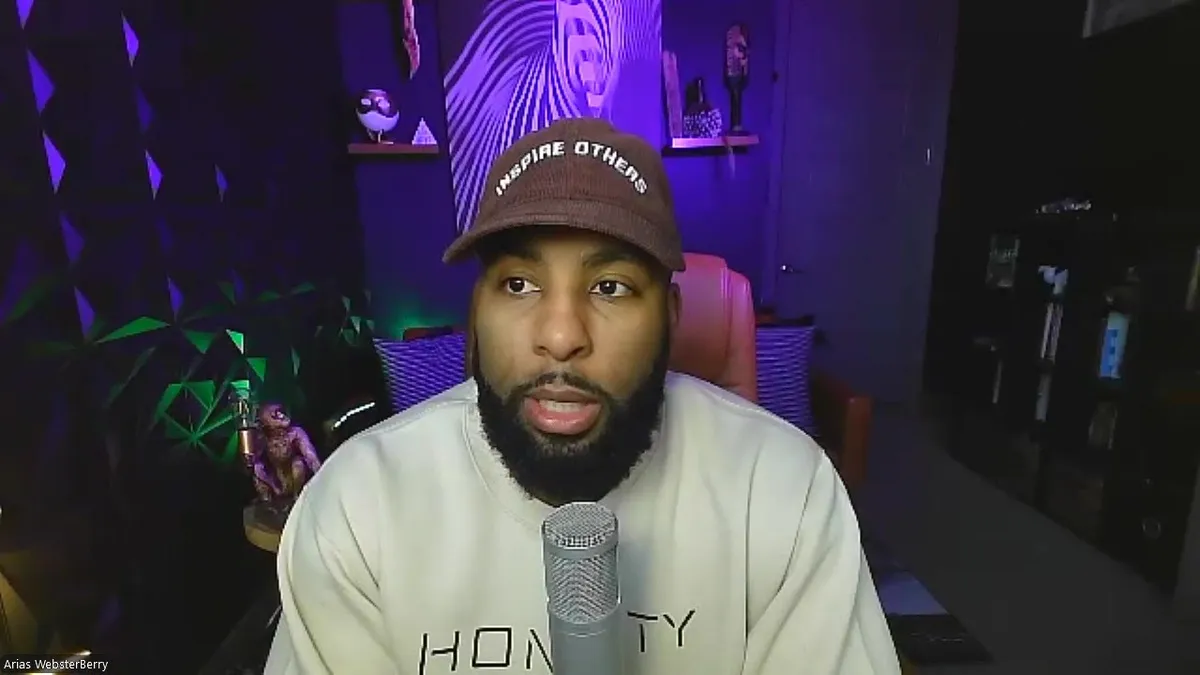
Make the Goal Bigger Than You Can Reach
Kevin McShan has been running Let's Have This Conversation for a thousand episodes, and mine happened to be the thousandth. He's a broadcaster who became one out of necessity — rejected ten times applying to be a sports reporter because he was born with cerebral palsy — so we spent most of the hour on access, opportunity and what actually removes a barrier.
Make the goal bigger than you can reach
Kevin asked about the 100X impact target: a thousand entrepreneurs reaching six figures, a hundred of them reaching seven.
When I set it, it looked a long way off. That's the point of it.
A vision should exceed your grasp. If you set a small goal and miss, nobody notices, including you, because you never stretched far enough for the gap to mean anything. Set something enormous and miss it by half, and you've still done something substantial.
The risk people worry about — embarrassment at falling short — is mostly imaginary. The real risk is aiming at something so modest that hitting it changes nothing.
Equity of opportunity, not equity of outcome
Kevin asked what conditions would let Black entrepreneurs thrive. My answer was collaboration, and I want to be precise about why.
A lot of conversation in minority business spaces focuses on equity of outcome. I'm far more interested in equity of opportunity. I don't think outcomes should be forced. I think access should be genuine, and then people should be able to compete.
What produces that, more than any policy I've seen, is people working together more often. Put two or three motivated, capable people in a room and things happen that none of them planned. Do that at scale, with more of us supporting each other and lending a hand, and there isn't much of a ceiling.
The thing that actually breaks down barriers
Kevin pushed further: how do you remove barriers to opportunity?
We've tried bureaucracy and law to level the field, and people disagree about how well that worked. I'll leave that argument to others. What I'm confident about is that proximity does something regulation can't.
It is very easy to villainise someone you never encounter. You absorb other people's characterisations, internalise them, and they become your own. Meeting the person directly makes that hard to maintain. You notice how much you have in common. It becomes difficult to hate someone you're in a room with, and much more likely you'll build something with them.
That's not a sentimental point. It's a practical one about how opinions actually change.
On hiring people with disabilities
Kevin asked what I'd say to employers about it, and my answer is blunter than the usual one.
If you want to motivate your team, hire people with disabilities. Some of the hardest-working people I've worked with. Early in, late out.
And there's a second effect nobody mentions. Your other employees notice. Someone doing the same job, possibly better, with an obstacle they don't have, removes every available excuse from the room. It puts things in perspective faster than any speech from management.
FORM
He asked about networking, and I taught this to my sales teams when I was a manager. If you want to be seen as a good conversationalist, use FORM.
F — Family, or where you're from. Married? Kids? Where did you grow up? You're looking for common ground, and there's almost always some.
O — Occupation. What do you do? Let them talk about it.
R — Recreation. What do you do when you're not working?
M — Message. Only now. Once you know where they're from, what they do and what they enjoy, you'll usually see whether there's a genuine reason to work together — and if there is, you've earned the right to say so.
Most people lead with M and wonder why conversations don't go anywhere.
The underlying principle is the same one that governs sales, and it's why I started running a monthly networking event: you can skip an enormous number of steps by knowing the right people, but only if you're interested in them first.
What success actually means
In the States we define success as the big house, the car, the watch. That isn't everyone's version and it isn't mine.
Mine is doing work I love, contributing something of value to the people I serve, taking care of my family long term, and leaving my children and their children with more than I started with. Not everything — I don't think that helps anyone — but something to start from.
The trips and the cars are pleasant. They aren't the measure.
Learning leadership without a template
Kevin asked how I developed as a leader without my father.
Poorly, and slowly. That's the honest answer.
After he died during my freshman year of high school, and then losing my remaining support in college, I was angry and rudderless for a long stretch. I wasted years acting out without recognising it as a response to the hand I'd been dealt.
What eventually changed it was finding something I was good at and could build a living from. That gave me a reason to learn discipline — how to lead a team, how to lead myself, how to be on time and be a man of my word. You make enough mistakes and you work out which things you have to get right, and then you have to do them consistently.
There was no shortcut and there wasn't a mentor handing me the template. There was just enough failure to make the lesson unavoidable.
Listen to the full episode
Watch on YouTube | Listen on Spotify | Listen on Amazon Music
Focusing on Opportunities in Business Rather Than Outcomes. Let's Have This Conversation with Kevin McShan, January 2025 — the show's 1,000th episode.
Congratulations to Kevin on a thousand. That's a level of dedication most people never get near.
Turning attention into revenue is the part most marketing skips. That's what Ignite Funnels is built for.


