AI Is Killing Creativity. I Say That as Someone Who Sells It.
Iredafe asked me on Creativity Boost what I made of the argument that AI is killing creativity. He probably expected pushback, given that I build AI products for a living.
I agreed with it.
Show your work
I'm old enough to remember when calculators were a big deal. In school, the rule was: show your work. You learned to do the thing by hand, wrote down every step, and proved you understood how you got to the answer. Only after that did they hand you the calculator.
What I see now, particularly with younger people, is that step being skipped entirely. Straight to the tool, without ever embodying the understanding underneath it.
The cost shows up in a specific way. You ask AI a question, it returns something, and that becomes your answer — because you never had a picture in your head of what you were trying to make. You're not evaluating the output against your own idea. You're waiting for it to supply the idea, then working from whatever it gave you.
That's not a tool problem. That's an ownership problem.
Originality is the whole game
There's enormous opportunity in generative models right now, in video, graphics, copy, animation. But without an original idea, an original angle, an original approach, everything you make will look like everyone else's.
A million people are using the same system, asking it roughly the same things, and getting roughly the same results back.
The differentiator isn't access to the tool. It's whether you took a moment to gather your own thinking first, so that you're using it as a tool rather than it using you.
Most people are more creative than they think
Almost every business owner I talk to tells me some version of "I never thought I was creative." That's because we've defined creativity as either wild success or visual expression. Build a spaceship, paint something, launch an app that makes a billion dollars in year one.
I find most of my creativity in systems. I use it to build businesses, to design products, to solve operational problems.
We created a service called Social Authority by taking our PR department and our social media management and fusing them into one thing. That's creativity. Looking at a problem and finding a unique way to solve it by combining two things nobody had combined.
Be more liberal about what counts, and you'll find almost everyone is creative in some direction.
Start with the result, not the idea
The most common mistake I see in people building something new is starting from the idea rather than the outcome. You end up with something genuinely cool that solves nothing, which means nobody cares.
Start with the problem. Not "I want to make great content" but "engagement on my account is low; how do I raise it?" Then work backwards. Same effort, completely different output, because now the work has a job to do.
And validate before you build. It has never been easier to stand in the public square and say: I'm thinking about making this, would anyone want it? If people respond, you may have something. If they don't, adjust and ask again. Then treat your first users as beta testers and treat their feedback like gold.
Launch Ignition started as a couple of spreadsheets, me talking endlessly on video, and some group sessions. It became a product because we listened the whole way through, not because I decided I knew what people wanted and spent a fortune building it in private.
Fundamentals still decide who lasts
People treat AI as a shortcut past the learning curve. Music has a useful parallel: the one-hit wonder. Someone goes up fast, comes down just as fast, and everyone remembers the song but not the artist. Without fundamentals, they can't tell you what produced the success, which means they can't repeat it.
Business is the same. If you stumble into a good quarter without understanding the machine behind it, you can't scale it, duplicate it, or defend it.
Related, and this is the line I'd want people to take away: you need a commitment to excellence, not to technology. These systems run on patterns, and if the model or the data is flawed, the pattern is flawed. Checking what goes out under your name is your job. Abdicating that to a machine is how something eventually gets published that doesn't represent you at all.
The next three to five years
My honest view is that a lot of people who aren't paying attention right now will be out of a job or out of business inside three to five years.
Two things protect you. Build a brand — be known for something, whether you're an entrepreneur or an employee. And get these tools into your daily workflow now, with or without corporate approval, so you become the most efficient person in the building rather than the most replaceable.
There's a third option worth naming. An enormous number of small businesses would love to adopt this and have no idea how. If you've learned a system at a large company, you can teach it to a smaller one. That's a second income, and it exists whether or not your employer keeps you.
Either you grab a surfboard, or you stand on the beach holding it while the wave arrives.
What I'd tell myself five years ago
Fail faster.
Everything is an experiment, and nobody knows in advance what works. So run more experiments, quicker. If someone tries one thing a month and you try five, by year-end they've learned twelve things, and you've learned sixty. Time is the only thing you can't buy back.
Watch the full conversation
Find it on your platform of choice
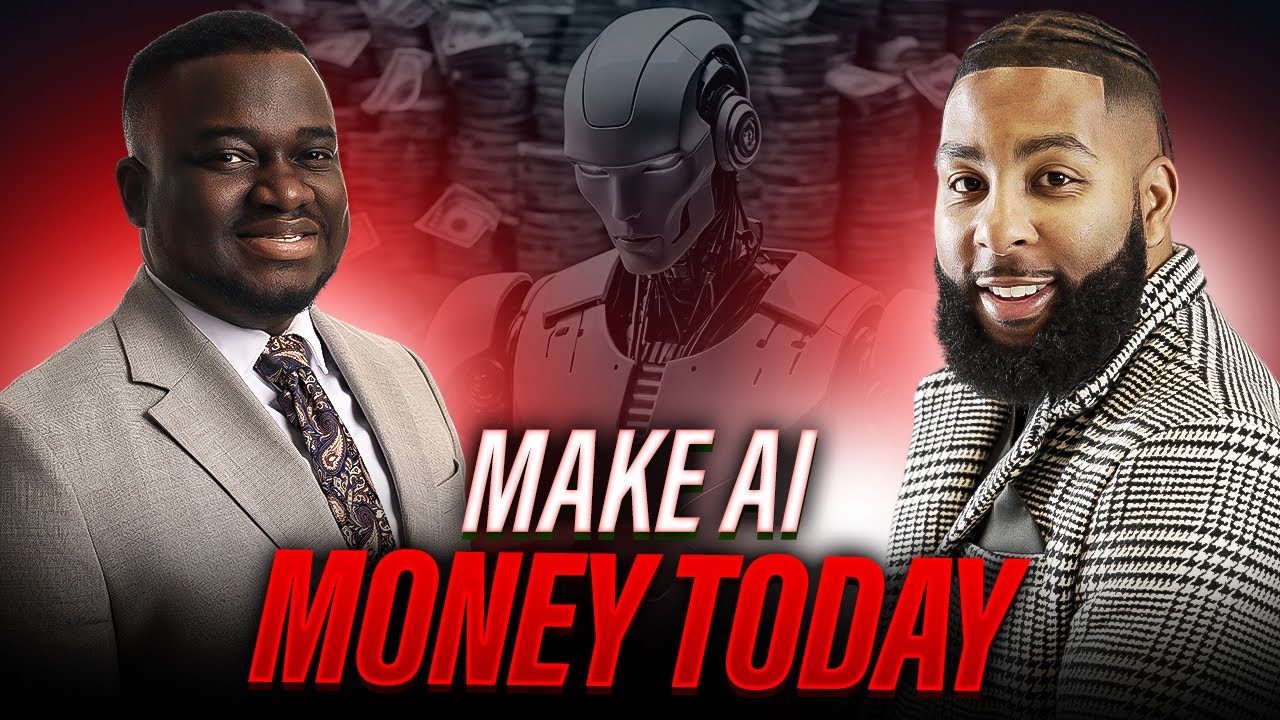
Episode: How to Make Money with AI Today. Creativity Boost with Iredafe Owolabi, September 2025. Runtime 43 minutes. My second appearance on the show.
The systems side of all this is what we build at Ignite Funnels — automation that handles the repeatable work so you can spend your attention on the part a machine can't do.


